Nursery and Childcare in Myoko: Kodomo-en, Applications and Fees
This guide is for families with young children who are moving to Myoko, or who stay for long periods. It explains how Myoko's nurseries and kodomo-en (certified centres for early education and care) work, when to apply and how fees are set. It also covers a new scheme that lets parents use a nursery for a few hours a month, whether or not they work.
Everything below comes from Myoko City's childcare pages, read on 28 October 2026. Dates and rules are set each year, so check the linked pages or ask the city's Children and Education Division before you apply. This is general information.
Three types of place
Myoko City sorts children into three groups when they apply:
- Type 1: children aged three and over who receive early education at a kodomo-en, similar to the old kindergarten.
- Type 2: children aged three and over who need childcare.
- Type 3: children under three who need childcare.
Types 2 and 3 are for families where the child "needs childcare". The city lists the reasons, which include:
- the parents work,
- pregnancy or childbirth,
- a parent's illness or disability,
- caring for a relative,
- recovering from a disaster,
- looking for work, and
- study.
The city says that, after review, it may decide that a Type 2 or 3 child does not need childcare.
Applying for the April 2027 intake
For places starting in fiscal 2027, the application window has already closed. The city's timetable was:
- Applications: 1 to 30 September 2026, to the city's Children and Education Division or to the centre. For Types 2 and 3, attach proof of the reason, such as an employment certificate.
- Interviews: at the first-choice centre, mid-October to mid-November.
- Allocation: after the interviews, until December.
- Acceptance letters: mid to late January.
- Parent briefings: February to March.
The city asked families who want a place partway through fiscal 2027, for example after parental leave, to apply in the same window. If you move to Myoko later, contact the city about places during the year, and check the city's page for the next intake's dates.
Centres in Myoko
Myoko City lists its certified centres and nurseries, with addresses, phone numbers and the ages they take. In the Myoko Kogen area, the list includes Myoko Kogen Kodomo-en in Taguchi. Most certified centres take children who need childcare from six months, and children for early education from three years.
How fees are set
Myoko City explains that centres are funded by national, prefectural and city money, plus fees from parents. Fees depend on:
- the child's age on 1 April,
- the hours of care needed (standard or short hours), and
- the parents' municipal resident tax.
The city sets the fees within a national upper limit. They are based on the resident tax of both parents, and sometimes of another relative who supports the family and heads the household. Fees change each September, when the new year's resident tax figures apply. The city publishes a fee table for children under three.
For a family that has just moved from overseas, this matters: the fee is tied to Japanese resident tax, which is based on the previous year's income in Japan. Ask the city how it will set your fee.
A few hours a month: the "Anyone Can Attend" scheme
From April 2026, a new national scheme called "Kodomo Daremo Tsuen" (Anyone Can Attend) has started across Japan, and Myoko City runs it. It lets a child spend a few hours at a nursery, whether or not the parents work.
- Who: children from six months to just before their third birthday who do not already attend a nursery, kindergarten or similar.
- How much time: about 10 hours per child per month. Unused hours do not carry over.
- Cost: ¥300 per hour (part hours are rounded up), ¥160 for lunch and ¥20 for a snack. Low-income households can apply for a reduction.
- Where: the city's eight public nurseries and certified centres, and one private centre.
To use it, apply online once through the national Children and Families Agency site, or at the city office. After that, book a first meeting at the centre, then book sessions at least seven days ahead. The city bills by the month. The city says bookings depend on each centre's staff and numbers, so your preferred day may not be available.
Occasional care
Myoko's centres also offer occasional care for children who are not enrolled. The city publishes the details and a registration form as PDF files.
What we could not verify, and therefore left out
- Fees for children aged three and over.
- How the fee is set for a family with no Japanese resident tax record yet.
- Whether places are usually available partway through the year in the Myoko Kogen area.
- Whether any centre can communicate in English.
- The current terms of occasional care, since the city's PDF dates from 2022.
Related guides
- Enrolling Your Child at a Myoko Public School: A Guide for Foreign Families
- Myoko Home Subsidies: Buying, Renovating and Moving In, Who Qualifies
More from the Journal
Browse every guide in the Myoko Kogen Journal. This guide is general information.
Sources
All URLs retrieved 2026-10-28.
- Myoko City — 市内認定こども園・保育園 令和9年度入園案内 (types of place, reasons, application dates and schedule): https://www.city.myoko.niigata.jp/docs/30.html
- Myoko City — 妙高市内の認定こども園・保育園 (list of centres and ages): https://www.city.myoko.niigata.jp/docs/316.html
- Myoko City — 認定こども園・保育園の保育料表 (fee tables): https://www.city.myoko.niigata.jp/docs/29.html
- Myoko City — 保育料の算定方法 (PDF: how fees are set): https://www.city.myoko.niigata.jp/fs/2/6/7/3/5/9/_/%E4%BF%9D%E8%82%B2%E6%96%99%E3%81%AE%E7%AE%97%E5%AE%9A%E6%96%B9%E6%B3%95.pdf
- Myoko City — こども誰でも通園制度について (the Anyone Can Attend scheme): https://www.city.myoko.niigata.jp/docs/78081.html
- Myoko City — 認定こども園・保育園の一時保育について (occasional care): https://www.city.myoko.niigata.jp/docs/3663.html
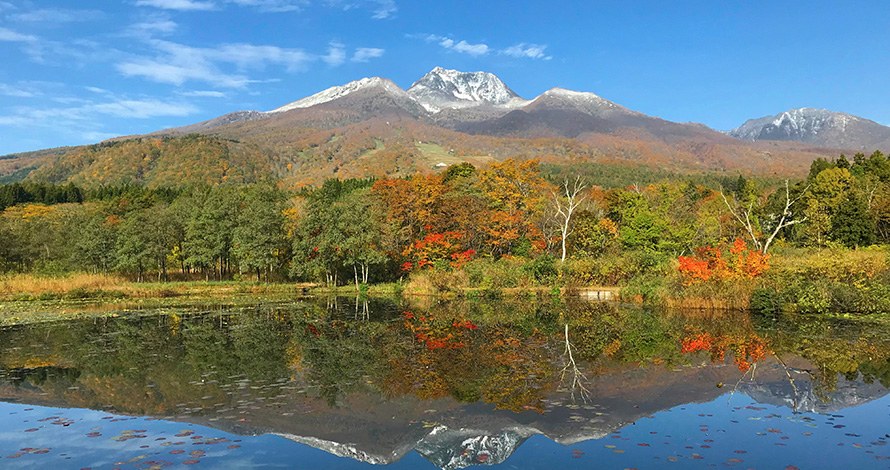
Header photo: “Mount Myoko with early snow, reflected in the still water of Imori Pond, with autumn trees along the shore” (Ministry of the Environment, Japan / 環境省), https://www.env.go.jp/nature/nationalparks/list/myoko-togakushi-renzan/spot/. Edited (cropped and resized) for use as the header image on this page. Used under the Public Data License (PDL) Version 1.0.