Who Clears the Snow in Myoko: City Ploughs, Your Entrance and Parking
This guide is for owners and guests at a house in Myoko over winter. Myoko City ploughs its roads early every snowy morning, but the plough cannot clear your driveway, and it relies on residents to follow a few rules. This guide explains how the city's snow clearing works, what it asks of you, and where to check the ploughs' progress.
Everything below comes from Myoko City's snow clearing pages, read on 23 October 2026. Plans are set each winter, so check the linked pages for the current season. This is general information about the city's published practice.
When the ploughs go out
Myoko City makes a snow clearing plan each year for city roads. The city says clearing keeps traffic moving, and also matters for fire fighting and rubbish collection in winter.
- The ploughs start work when roughly 10 cm of snow has fallen.
- On early-morning runs, the city aims to finish by 7:00 a.m. in the Arai and Myoko areas, and by 6:30 a.m. in the Myoko Kogen area.
- From 16 November, the city runs a snow clearing headquarters within its Construction Division.
The city says one plough's round takes about five to six hours. Machines are limited, routes are long, and narrow roads and obstacles slow the work. In heavy snow the plough may come later.
Not every road gets the same service
City roads are graded, and the grade decides how wide and how often they are cleared:
- Special routes (in town, including snow-haulage roads): 1.5 lanes (5 metres) from 7 a.m. to 7 p.m., even under a heavy snow warning, and one lane at other times.
- All-day routes (busy roads linking to national and prefectural roads): one lane kept open all day, even in heavy snow.
- Class 1: two lanes, open at all times except in unusual snowfall.
- Class 2: the width needed, sometimes one lane with passing places.
- Class 3: one lane with passing places. When the city moves to its alert setting, clearing may stop for a time on some sections.
Some narrow roads, or roads not needed for winter life, are cleared only when the snow starts to melt. A road map of the grades is linked from the city's snow and traffic page.
When the city goes on alert
If snow at the city's observation points reaches a set depth, the city may move to an alert setting. The depths are 200 cm in Arai, 300 cm in Myoko Kogen and 250 cm in Myoko. In very heavy snow, the mayor leads a heavy snow headquarters, and the priority becomes keeping the main roads open.
Your entrance is your job
The city says plainly that it cannot clear each house's entrance or adjust its clearing to each home. The plough may leave a ridge of snow across your gate or garage. Because of how the machines work, the city says it is hard to avoid this, and it asks each household to clear it themselves.
For a holiday home, this matters. If nobody is there after a heavy fall, the entrance and the car space can be blocked by the time you arrive. Plan who will clear it.
What the city asks of residents
- Do not push snow onto the road or footpath. It narrows the road and makes it uneven, which causes accidents. Snow from your land should, in principle, stay on your land.
- Do not dam roadside gutters to melt snow with the overflow. It bothers road users and can flood houses.
- Do not leave objects on the road.
- Never park on the road. Parked cars block the ploughs and emergency vehicles.
- Keep away from working ploughs, especially with small children.
- Trim overhanging branches and clear roof snow early, so that snow does not fall onto the road and hurt someone.
- Use snow channels (ryusetsu-ko) by the rules. Do not remove the cross-shaped grille to push in large lumps of snow. Blockages can flood houses downstream. Mark the opening while you work, and put the lid back when you finish.
The city also asks for understanding about early-morning noise, ploughs crossing the centre line, and short detours or one-way traffic while they work.
Checking where the ploughs are
Myoko City publishes the position of its ploughs online, so you can see how far the work has reached. The city's snow and traffic page links to:
- the plough position map, with a QR code for smartphones and a text version for other mobile phones,
- daily snow depth readings taken at 9 a.m. at three points, including the Kogen area fire station,
- the city's live cameras, and
- road and train information from the national road office, NEXCO East, Echigo Tokimeki Railway and Shinano Railway.
The city also suggests registering for its official LINE account for easier access.
Help for narrow roads and older residents
The city has support schemes. Local groups can get help to clear city roads, or to buy or lease a small snow blower. They can also get help to install and run snow-melting pipes. For older people living alone and similar households, the city helps with the cost of roof snow clearing and with keeping a path open. Each scheme has conditions, so contact the city first.
A checklist for a winter house
- Arrange someone to clear your entrance and car space after heavy snow, especially when the house is empty.
- Make sure there is off-road parking for every car, including guests'.
- Tell guests not to throw snow onto the road.
- Bookmark the plough position map and the snow depth readings.
- Trim trees that hang over the road before winter.
What we could not verify, and therefore left out
- The grade of the road in front of any particular house.
- Whether the city's plough map works in English.
- Fines or penalties for parking on the road in winter.
- Clearing practice on private roads inside resort subdivisions.
- The opening dates of the city's snow dumping sites this season.
Related guides
- Clearing Roof Snow in Myoko Safely: Official Advice and Accident Numbers
- Winter Roads Around Myoko: Chain Rules, Closures and Where to Check
More from the Journal
Browse every guide in the Myoko Kogen Journal. This guide is general information, not legal advice.
Sources
All URLs retrieved 2026-10-23.
- Myoko City — 道路除雪についてのよくある質問と回答 (when ploughs start, early-morning targets, entrances, snow on roads, gutters, parking, snow channels): https://www.city.myoko.niigata.jp/docs/418.html
- Myoko City — 除雪体制 (headquarters, alert depths, road grades): https://www.city.myoko.niigata.jp/docs/423.html
- Myoko City — 除雪についてのお願い (what the city asks of residents): https://www.city.myoko.niigata.jp/docs/426.html
- Myoko City — 除排雪等支援制度 (support schemes): https://www.city.myoko.niigata.jp/docs/419.html
- Myoko City — 雪・交通情報 (plough positions, snow depth readings, live cameras, road and rail links): https://www.city.myoko.niigata.jp/docs/398.html
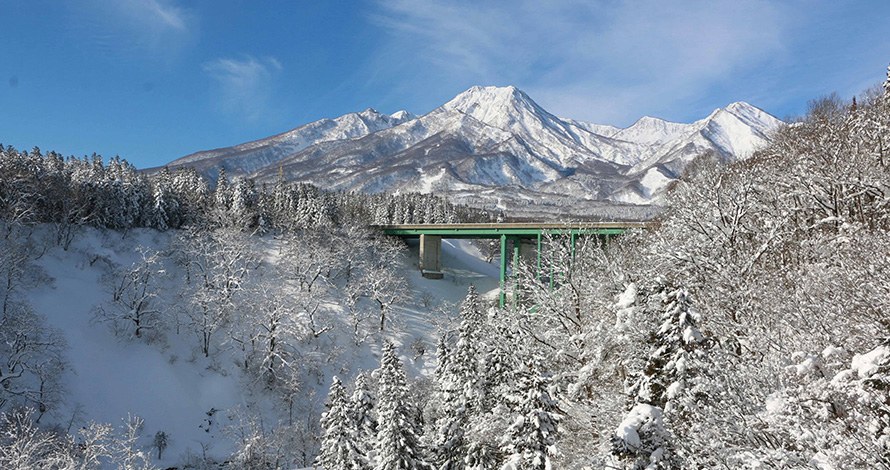
Header photo: “Snow-covered Mount Myoko above a forested valley, with a road bridge crossing the gorge” (Ministry of the Environment, Japan / 環境省), https://www.env.go.jp/nature/nationalparks/list/myoko-togakushi-renzan/spot/. Edited (cropped and resized) for use as the header image on this page. Used under the Public Data License (PDL) Version 1.0.