Septic Tanks (Jokaso) in Myoko Houses: What the Owner Must Do Each Year
Parts of Myoko are not on the sewer. Houses there clean their toilet and household waste water on site, in a septic tank called a jokaso. Japanese law gives the person in charge of that tank three jobs every year: maintenance checks, cleaning, and an official water-quality inspection. If you buy a house with a jokaso, those jobs become yours. This guide is for overseas buyers and owners. It explains what the duties are and how most owners hand the work to professionals.
Everything below comes from the Johkasou Act and the Ministry of the Environment's rules under it (both on Japan's e-Gov law database), a Niigata Prefecture leaflet, and Myoko City's Guidebook for Living in Myoko. We read all of them on 13 October 2026. This is general information, not legal advice. For your own tank, ask the city, the prefecture or your contractor.
First, find out whether the house has one
Myoko City's guidebook says some areas of the city are not served by the sewerage system and may have septic tanks. If you buy an existing building, or build outside the sewerage area, the city asks you to check with the agent or builder whether a septic tank is installed. If there is one, the city asks you to hand its management and inspection to a professional contractor.
If a house inside the sewerage area still uses a septic tank, the city asks the owner to connect to the sewer as soon as possible. For houses that use neither, where toilet waste is collected, the contact is the city's Environmental and Lifestyle Division.
What a jokaso does
Niigata Prefecture describes a jokaso as a device that uses microorganisms to clean human waste and household waste water. The prefecture says it treats water to almost the same level as the sewerage system. But it only works properly if it is looked after through maintenance checks, cleaning and the statutory inspection.
If you want to read more in English, Japan's Ministry of the Environment (which spells the word johkasou) publishes English material on these systems, including a tentative translation of the Act.
You are the "jokaso manager"
The Act puts the duties on the jokaso kanrisha, or jokaso manager. That is the owner, the occupier, or anyone else with authority over managing the tank (Article 7). For a house you own, assume this is you.
When the manager changes, for example after you buy the house, the new manager must send a report to the prefectural governor within 30 days of the change (Article 10-2(3)). Niigata's leaflet says notices such as a change of manager or taking a tank out of use go to the administrative office.
Duty 1: maintenance checks
Article 10 requires maintenance checks (hoshu tenken) once a year, or more often where the ministry's rules say so. For many household tanks, they do say so. Article 6 of the rules names three common small types: separation contact-aeration, anaerobic filter contact-aeration and denitrification filter contact-aeration. If one of these is sized for 20 people or fewer, it needs a check at least once every four months. Some other types need checks every week or two. The first check should be done just before the tank comes into use (Article 5).
Niigata compares maintenance to the routine servicing of a car. The contractor inspects the tank, adjusts or repairs it, and tops up chemicals.
Duty 2: cleaning
Cleaning (seiso) means pumping out the sludge that builds up inside the tank. The Act requires it once a year (Article 10). For the full-aeration type, the rules say roughly once every six months (Article 7).
You may hand maintenance to a registered maintenance business, where the prefecture has a registration system, or otherwise to a certified jokaso technician. Cleaning goes to a licensed cleaning business (Article 10(3)). Myoko's guidebook gives the same advice in short form: hire a registered contractor for maintenance, and only sign a contract with a specialist.
Duty 3: the statutory water-quality inspection
This is separate from maintenance. Once a year, the manager must have the tank's water quality inspected by an inspection agency designated by the prefectural governor (Article 11). Niigata compares it to the shaken, the official roadworthiness test for cars. It checks whether the tank is working as it should, including whether maintenance and cleaning are being done properly.
- A newly installed tank also needs a first inspection (Article 7). Niigata says this falls between three and eight months after the tank comes into use.
- A simpler route in Niigata. For tanks sized for 20 people or fewer, the prefecture runs a streamlined annual inspection. A sampler from the maintenance company does the site check and takes a water sample. The inspection agency then analyses it and makes the overall judgement.
- Paperwork can be delegated. The manager may ask the company that does the maintenance or cleaning to handle the inspection procedure (rules, Article 9).
Skipping the inspection has consequences. Niigata's leaflet says that if a tank is not inspected and a public-health problem is found, the prefecture can issue a recommendation and then an order. Breaking that order can lead to a non-criminal fine of up to ¥300,000 (Act, Articles 12-2 and 66-2).
Keep the records
A contractor who does your maintenance or cleaning must make a record, give it to you and explain what it says. You, as the manager, must keep those records for three years (rules, Article 5). Paper or electronic copies both count, if you agreed to electronic delivery.
House rules for anyone using the tank, guests included
The Act requires everyone who uses a jokaso to follow the ministry's rules of use (Article 3(3)). Article 1 of the rules lists them. They are worth printing for guests:
- Use a sensible amount of water to flush.
- Do not let insecticides, detergents, deodorisers, oil and fat, disposable nappies, sanitary products or anything else that disrupts the tank go down the drain.
- Keep rainwater and other unusual waste water out.
- If the tank has electrical equipment, do not switch off its power.
- Do not build anything on or around the tank that would get in the way of maintenance or cleaning, and do not put heavy loads on top of it.
- Do not block the vent openings.
- If you notice a fault or anything unusual, tell the jokaso manager straight away.
If the house will stand empty
The Act has a formal way to pause the duties. If you clean the tank when you stop using it, you may notify the prefectural governor that its use is suspended (Article 11-2(1)). While that notice stands, the yearly maintenance, cleaning and inspection duties do not apply (Articles 10 and 11). When use starts again, you must notify the governor within 30 days (Article 11-2(2)). Failing to do so, or making a false notice, can lead to a non-criminal fine of up to ¥50,000 (Article 68).
Older "toilet-only" tanks
Some older houses have a tank that treats only toilet waste, known as a tandoku (single-treatment) tank. Kitchen and bath water from those houses is not treated by the tank. Under the 2000 amendment, these tanks are still treated as jokaso under the Act. Their users must keep kitchen and bath water out of them (rules, Article 1). The same amendment asks their users to try to install a jokaso that treats household waste water as well (Supplementary Provisions, Article 3). If you are looking at an older house, ask which type it has.
A short checklist for buyers and owners abroad
- Before you buy, ask the agent or builder whether the house is on the sewer or has a jokaso, and which type.
- Ask the seller for the last three years of maintenance and cleaning records, and the latest inspection result.
- Within 30 days of becoming the manager, send the change-of-manager report.
- Sign contracts with a registered maintenance business and a licensed cleaning business, and ask them to arrange the yearly inspection.
- Leave the rules of use in the house for guests and family.
What we could not verify, and therefore left out
Whether the change-of-manager report for a Myoko house is handled by the prefecture or by Myoko City (Niigata's leaflet lists both prefectural and municipal contact points); what maintenance, cleaning and inspection usually cost in Myoko; whether Myoko offers any subsidy for replacing an old tank; whether contractors or the inspection agency can work in English; and whether a holiday home used for part of the year can use the suspension notice.
Related guides
More from the Journal
Browse every guide in the Myoko Kogen Journal. This guide is general information, not legal or tax advice.
Sources
All URLs retrieved 2026-10-13.
- Myoko City — 外国人生活ガイドブック Guidebook for Living in Myoko (section 20, Private Sewerage System and Septic Tanks): https://www.city.myoko.niigata.jp/docs/113.html
- e-Gov Laws — 浄化槽法 Johkasou Act (Articles 3, 7, 10, 10-2, 11, 11-2, 12-2, 66-2, 68; Supplementary Provisions of the 2000 amendment, Articles 2 and 3): https://laws.e-gov.go.jp/law/358AC1000000043
- e-Gov Laws — 環境省関係浄化槽法施行規則 Ministry of the Environment rules under the Johkasou Act (Articles 1, 4, 5, 6, 7, 9): https://laws.e-gov.go.jp/law/359M50000100017
- Niigata Prefecture — 法定検査を受けましょう leaflet for jokaso users (March 2026; first and annual inspections, streamlined inspection, ¥300,000 fine): https://www.pref.niigata.lg.jp/uploaded/attachment/487314.pdf
- Ministry of the Environment — About Johkasou (English material, including a tentative translation of the Act): https://www.env.go.jp/recycle/jokaso/en/
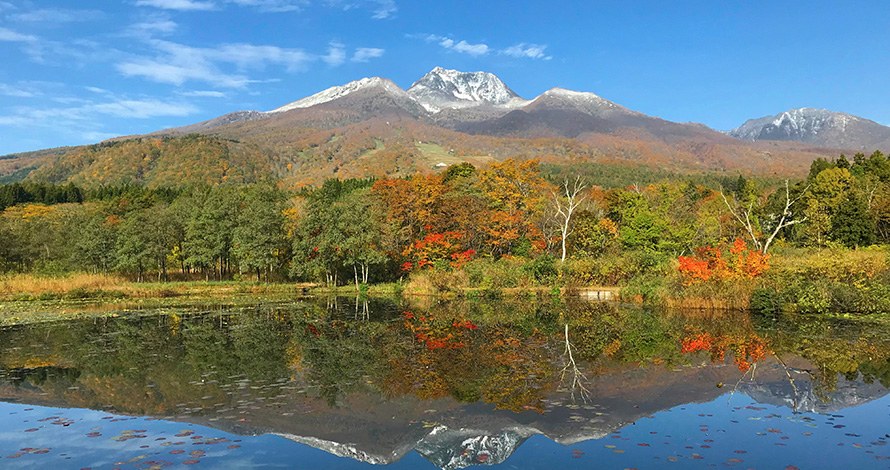
Header photo: “Mount Myoko with early snow, reflected in the still water of Imori Pond, with autumn trees along the shore” (Ministry of the Environment, Japan / 環境省), https://www.env.go.jp/nature/nationalparks/list/myoko-togakushi-renzan/spot/. Edited (cropped and resized) for use as the header image on this page. Used under the Public Data License (PDL) Version 1.0.