Okakura Tenshin and the Rokkakudo: The Book of Tea's Author in Akakura
Akakura Onsen is best known for skiing and hot springs, but a short walk from the village is a quiet garden with a six-sided hall. It honours Okakura Tenshin, the art historian who wrote The Book of Tea and spent his last years at a mountain villa here. This guide explains who he was, why he matters to Myoko, and what you will find at the Rokkakudo.
Everything below comes from Myoko City and the Japan Tourism Agency's multilingual commentary database, read on 5 November 2026. The site closes in winter, so check before you go.
What the Rokkakudo is
- Where: less than a kilometre's walk from Akakura Onsen, in a small, secluded garden.
- What: the Rokkakudo, which means "hexagonal hall", built in 1959 in memory of Okakura Tenshin. A gold-enamelled bust of Okakura is enshrined inside.
- Around it: the garden and its monuments were built to honour his life's work. The Japan Tourism Agency's description says visitors can read about his contributions to Japan there.
- When: Myoko City says the park is closed in winter because of heavy snow.
Who Okakura Tenshin was
Myoko City introduces Okakura (1862–1913) as an art historian and philosopher. It suggests that Westerners who have admired a Japanese woodblock print, or the aesthetics of the tea ceremony, may owe that in part to him and his writings.
- Early life: born in Yokohama to parents in the silk trade, he learned English at a local mission school and studied the Chinese classics at a temple.
- Student years: in 1875 he entered Tokyo Kaisei School, one of the two colleges that later merged to form the University of Tokyo. The city tells a story from this time. His first graduation thesis, "Theory of State", was burned in a quarrel with his wife. He wrote a second, "Theory of Art", in two weeks, and it set the course of his career.
- Protecting Japanese art: as Japan modernised fast and Western influence grew, he worked to preserve and promote traditional Japanese art. He joined the Ministry of Education and founded art institutions.
- Tokyo School of Fine Arts: the Japan Tourism Agency calls his co-founding of this school, now Tokyo University of the Arts, perhaps his most important achievement. He later became its head, and taught many students who became leading artists.
- Boston: in 1904 he became a curator at the Museum of Fine Arts, Boston. The agency says he headed its Asian division and was in charge of its Chinese and Japanese works.
- The Book of Tea: he wrote several books in English. The Book of Tea (1906) helped introduce the tea ceremony and its aesthetics to the West.
Why Akakura
Myoko City says that in later life Okakura often retreated to his mountain villa at Akakura Onsen, and he died there in 1913. The Japan Tourism Agency's description says his love for the Myoko area, and his decision to spend his later years here, have made him a proud adopted son of the region. It calls the site a cultural landmark for both locals and visitors from abroad.
Visiting
- Combine it with a walk from Akakura Onsen. The city says it is less than a kilometre away.
- Go between spring and autumn, since the park is closed in winter.
- Read The Book of Tea before you go. Okakura wrote it in English.
A note on dates
Myoko City gives Okakura's years as 1862–1913. One Japan Tourism Agency entry gives 1863–1913. Both agree that he died at Akakura in 1913.
What we could not verify, and therefore left out
- The exact months the park opens and closes, and whether there is an entry fee.
- Whether the hall's interior can be viewed.
- Parking and the walking route from Akakura Onsen.
- Whether any part of the original villa survives.
Related guides
- What Is Naena Falls? Myoko's 55-Metre "Earthquake Falls"
- Myoko Beyond Winter: Onsen, Green Season and What's Changing
More from the Journal
Browse every guide in the Myoko Kogen Journal.
Sources
All URLs retrieved 2026-11-05.
- Myoko City — Okakura Tenshin and the Rokkakudo (English): https://www.city.myoko.niigata.jp/docs/33880.html
- Japan Tourism Agency multilingual commentary database — 岡倉天心六角堂 (R3-00326): https://www.mlit.go.jp/tagengo-db/R3-00326.html
- Japan Tourism Agency multilingual commentary database — Okakura Tenshin Rokkakudo Hall (H30-00580): https://www.mlit.go.jp/tagengo-db/en/H30-00580.html
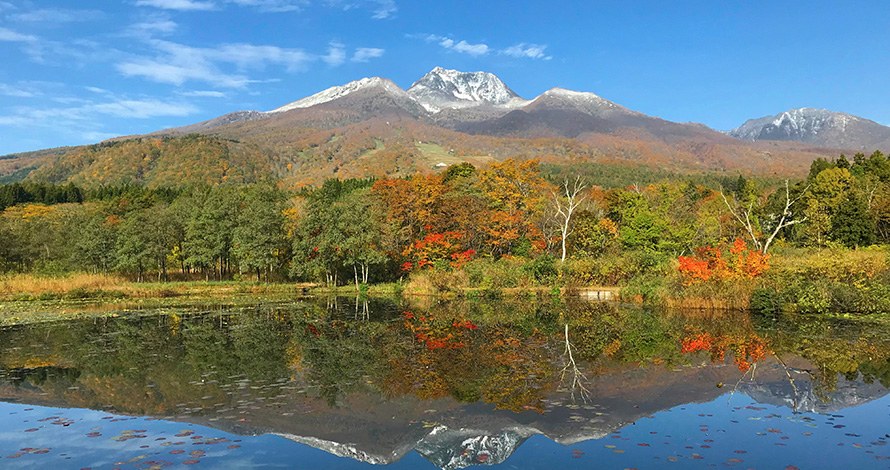
Header photo: “Mount Myoko with early snow, reflected in the still water of Imori Pond, with autumn trees along the shore” (Ministry of the Environment, Japan / 環境省), https://www.env.go.jp/nature/nationalparks/list/myoko-togakushi-renzan/spot/. Edited (cropped and resized) for use as the header image on this page. Used under the Public Data License (PDL) Version 1.0.