What Is Tsubame Onsen? Myoko's Highest Hot Spring and Its Free Outdoor Baths
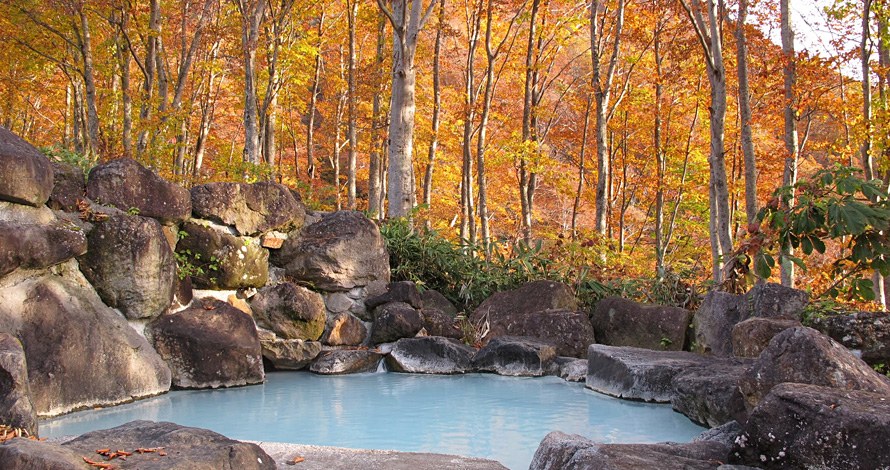
Tsubame Onsen is the highest of the hot spring villages on the slopes of Mt Myoko. It is known for its milky white water and for two free outdoor baths in the mountains. This guide explains what Tsubame Onsen is, how the two outdoor baths work through the year, the waterfall nearby, and how to get there. It is for visitors, and for owners who want to show guests something beyond the ski slopes.
Everything below comes from the Myoko Tourism Bureau, the Ministry of the Environment, the Japan Tourism Agency and Myoko City, all read on 11 November 2026. Bath seasons change every year, so check the bureau's news page before you go. Nothing here is medical advice.
What Tsubame Onsen is
- Height: about 1,100 m above sea level. The Ministry of the Environment says it is the highest of the seven hot spring villages around Mt Myoko.
- The water: milky white. The bureau says white flakes of hot spring minerals, called yu-no-hana, are a feature.
- The name: "tsubame" means swallow. The bureau says the village got its name because rock swallows once flew here in flocks.
- The setting: the village sits inside Myoko-Togakushi Renzan National Park.
Its story
The Myoko Tourism Bureau says the spring is said to have been found by Kobo Daishi, the Buddhist monk. Since long ago, hot water has welled up under the rock cave at Sotaki, the waterfall in the gorge nearby. Full development of the village began in 1875.
The bureau adds that Tsubame is also said to be a hidden bath of Uesugi Kenshin, the 16th-century warlord. These are local traditions, so read them as stories rather than history.
One of seven onsen, and the only white one
Seven hot spring villages make up the Myoko Kogen Onsen area. The bureau says their water comes in three colours besides clear: milky white at Tsubame, reddish brown at Seki, and black at part of Ikenotaira.
The Japan Tourism Agency describes the water at Tsubame as cloudy white and rich in sulphates, sulphur and bicarbonate. It also says the seven villages are close to each other, about a five- to ten-minute drive apart, so you can visit several in a day.
The bureau also calls Tsubame a "triple beauty bath", because the water contains three components said to be good for the skin. Health benefits listed by tourism sites are traditional claims. If you have a medical condition, ask a doctor before bathing.
The two free outdoor baths
The Myoko Tourism Bureau names two free outdoor baths at Tsubame, and calls them popular hidden spots:
- Kogane no Yu ("the golden bath"): separate baths for men and women.
- Kawara no Yu ("the riverbed bath"): a mixed bath.
Many hikers stop at them on the way back from climbing Mt Myoko. The baths are free, but the bureau asks visitors to put a donation in the box to help with cleaning and upkeep.
Both baths are closed on Monday and Friday mornings for cleaning. In 2025 the bureau added that when Monday is a public holiday, the cleaning moves to Tuesday morning.
When the baths are open
The two baths have different seasons, and the dates change every year. Here is what the bureau announced for 2026:
- Kogane no Yu opened for the season on 27 March 2026. At that time there was still more than 2 m of snow on the path from the car park, and the bureau said rubber boots were a must. In 2025, the season ended on 30 November.
- Kawara no Yu usually opens around June. In 2026 it could be used until 8 November. From 9 November, work began to remove its bridge, and it is now closed for the winter. At the time of that notice, the bureau said Kogane no Yu was still open.
Baths can also close at short notice. In 2025 both baths stayed closed until 11 July, after a pipe was blocked by a lump of hot spring minerals.
Sotaki Falls and the Otagiri gorge
The gorge of the Otagiri River around Tsubame Onsen is one of the most remote beauty spots in the Myoko area. Its best-known sight is Sotaki, an 80 m waterfall that is on the list of Japan's 100 best waterfalls.
The bureau says you can see the falls from a viewing platform about a 15-minute walk from the car park. It recommends the autumn leaf season most, when you can look at the golden gorge from Kogane no Yu.
Hikers: a trial entry fee this autumn
Tsubame Onsen is also a trailhead for Mt Myoko. From 1 October to 30 November 2026, there is a trial of a digital entry fee at the Tsubame Onsen trailhead, paid through a smartphone hiking app.
The bureau explains that the entry fee is a voluntary donation for protecting the natural environment. The national park in Myoko uses it to protect the rock ptarmigan and to maintain the trails. Questions go to Myoko City's environment section.
Getting there
Myoko City runs a city bus, the Seki and Tsubame Onsen line, from Sekiyama Station to Tsubame Onsen. The current timetable runs from 1 April 2026 to 31 March 2027. You can get on and off anywhere along the line, and some runs do not operate on weekends, public holidays, or from 31 December to 3 January.
The city says winter buses may run late when it snows. The summer sightseeing bus, the Myoko Sanroku line, also stopped at Tsubame Onsen, but its 2026 season ended on 3 November.
Visiting safely
The path to Kawara no Yu is rough. The bureau says not to wear sandals there, and suggests sneakers or trekking shoes. In early spring it said rubber boots were needed on the snowy path to Kogane no Yu. Tsubame is at about 1,100 m, so expect deep snow for much of the year, and check the bureau's news page before you set out.
What we could not verify, and therefore left out
- The date Kogane no Yu will close for the 2026 season.
- When Kawara no Yu will open in 2027.
- Whether the road to Tsubame Onsen stays open all winter, and parking in the snow season.
- Opening hours of the baths beyond the cleaning times above.
- Whether the trail section between Tsubame Onsen and Asadaira, closed in 2022 after a bridge was damaged by heavy snow, has reopened.
- Which inns in the village offer day bathing.
Related guides
- How Myoko Kogen Became a Resort: Akakura Onsen and the History of the Slopes
- Getting Around Myoko Without a Car: City Buses, Trains and Community Buses
More from the Journal
Browse every guide in the Myoko Kogen Journal. Our articles are general information only; check official sources before you travel.
Sources
All URLs retrieved 2026-11-11.
- Myoko Tourism Bureau — 温泉 (the seven onsen of Myoko Kogen; Tsubame Onsen): https://myokotourism.jp/onsen/
- Ministry of the Environment — 妙高戸隠連山国立公園 見どころ (Myoko Kogen Onsen area; Tsubame Onsen): https://www.env.go.jp/nature/nationalparks/list/myoko-togakushi-renzan/spot/
- Japan Tourism Agency multilingual commentary database — Myoko Kogen Onsen Area: https://www.mlit.go.jp/tagengo-db/en/H30-00575.html
- Myoko Tourism Bureau — 燕温泉「黄金の湯」今季オープンのお知らせ (Kogane no Yu opening, 27 March 2026): https://myokotourism.jp/news/%e7%87%95%e6%b8%a9%e6%b3%89%e3%80%8c%e9%bb%84%e9%87%91%e3%81%ae%e6%b9%af%e3%80%8d%e3%82%aa%e3%83%bc%e3%83%97%e3%83%b3%e3%81%ae%e3%81%8a%e7%9f%a5%e3%82%89%e3%81%9b-2/
- Myoko Tourism Bureau — 燕温泉「河原の湯」CLOSEのお知らせ (Kawara no Yu winter closure, 2026): https://myokotourism.jp/news/%e7%87%95%e6%b8%a9%e6%b3%89%e3%80%8c%e6%b2%b3%e5%8e%9f%e3%81%ae%e6%b9%af%e3%80%8d%e7%b5%82%e4%ba%86/
- Myoko Tourism Bureau — 燕温泉「黄金の湯」Closeのお知らせ (end of the 2025 season): https://myokotourism.jp/news/%e7%87%95%e6%b8%a9%e6%b3%89%e3%80%8c%e9%bb%84%e9%87%91%e3%81%ae%e6%b9%af%e3%80%8dclose%e3%81%ae%e3%81%8a%e7%9f%a5%e3%82%89%e3%81%9b/
- Myoko Tourism Bureau — 燕温泉「黄金の湯」「河原の湯」再開しました (2025 reopening and cleaning times): https://myokotourism.jp/news/%e7%87%95%e6%b8%a9%e6%b3%89%e3%80%8c%e9%bb%84%e9%87%91%e3%81%ae%e6%b9%af%e3%80%8d%e5%86%ac%e6%9c%9f%e9%96%89%e9%8e%96%e3%81%ab%e3%81%a4%e3%81%84%e3%81%a6/
- Myoko Tourism Bureau — 燕温泉 大田切渓谷・惣滝 (Otagiri gorge and Sotaki Falls): https://myokotourism.jp/autumn-colors/%e7%87%95%e6%b8%a9%e6%b3%89%e3%80%80%e5%a4%a7%e7%94%b0%e5%88%87%e6%b8%93%e8%b0%b7%e3%83%bb%e6%83%a3%e6%bb%9d/
- Myoko Tourism Bureau — 燕温泉登山口でのデジタル入域料実証実験について (digital entry fee trial, 2026): https://myokotourism.jp/news/%e7%87%95%e6%b8%a9%e6%b3%89%e7%99%bb%e5%b1%b1%e5%8f%a3%e3%81%a7%e3%81%ae%e3%83%87%e3%82%b8%e3%82%bf%e3%83%ab%e5%85%a5%e5%9f%9f%e6%96%99%e5%ae%9f%e8%a8%bc%e5%ae%9f%e9%a8%93%e3%81%ab%e3%81%a4%e3%81%84/
- Myoko Tourism Bureau — 「燕温泉~麻平 間」の登山道通行禁止のお知らせ (2022 trail closure notice): https://myokotourism.jp/news/%e3%80%8c%e7%87%95%e6%b8%a9%e6%b3%89%ef%bd%9e%e9%ba%bb%e5%b9%b3%e3%80%8d%e9%96%93%e6%ad%a9%e9%81%93%e3%80%80%e9%80%9a%e8%a1%8c%e7%a6%81%e6%ad%a2%e3%81%ae%e3%81%8a%e7%9f%a5%e3%82%89%e3%81%9b%e3%80%80/
- Myoko City — 妙高市市営バス (city bus lines; Myoko Sanroku line 2026 season): https://www.city.myoko.niigata.jp/docs/892.html
- Myoko City — 関・燕温泉線 時刻表(令和8年4月1日から令和9年3月31日まで) (Seki and Tsubame Onsen line timetable): https://www.city.myoko.niigata.jp/fs/2/8/5/9/6/8/_/R8_03_sekitsubame.pdf
Header photo: “An outdoor hot-spring pool with pale blue water among rocks and golden autumn beech trees” (Ministry of the Environment, Japan / 環境省), https://www.env.go.jp/nature/nationalparks/list/myoko-togakushi-renzan/spot/. Edited (cropped and resized) for use as the header image on this page. Used under the Public Data License (PDL) Version 1.0.